
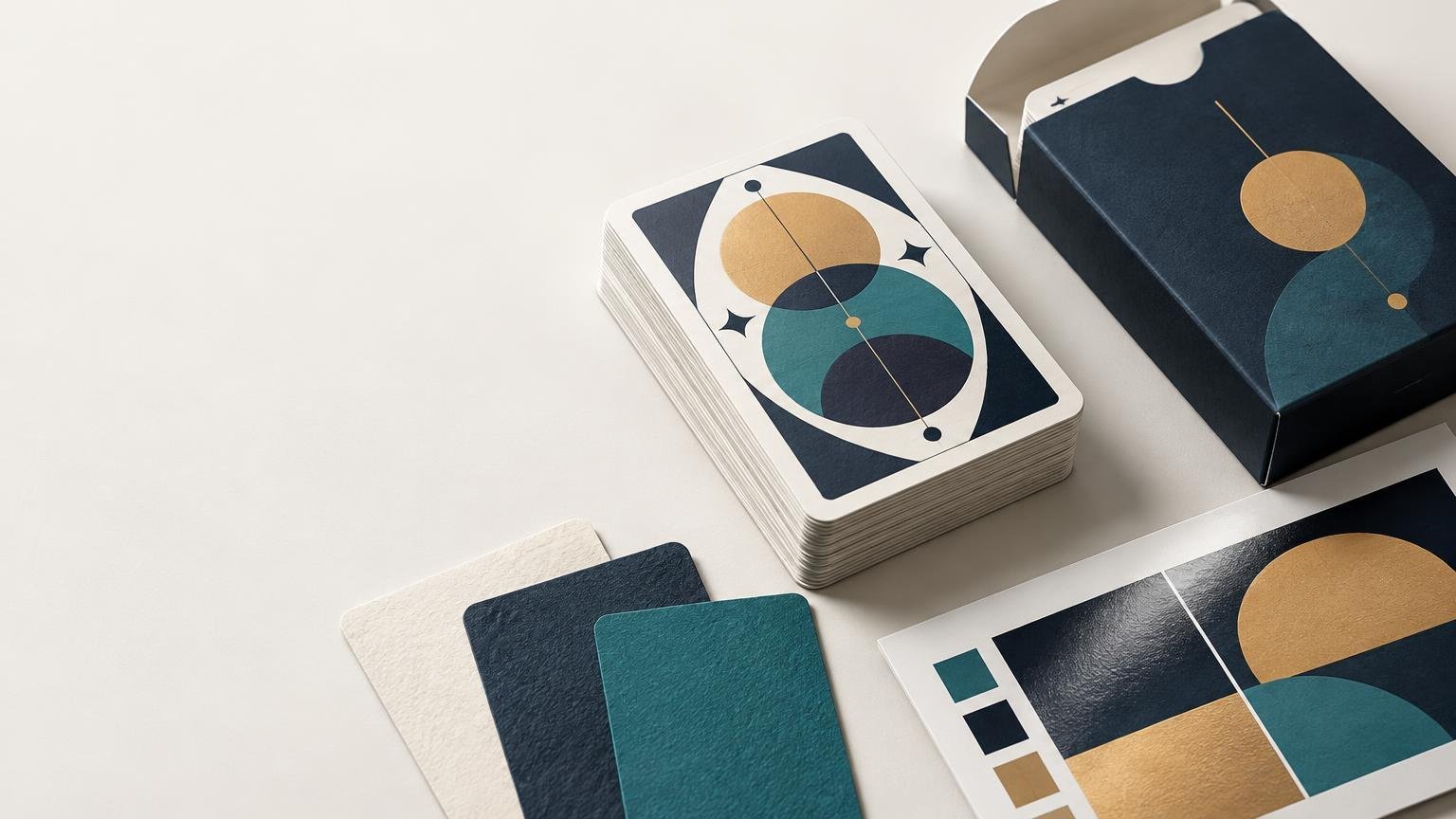
Custom card printing cost is driven primarily by the number of cards per deck, production quantity, finished size, stock, finish and packaging. Shipping, proofing and one-time setup charges then determine what you actually pay. For most projects, the best value comes from choosing a standard card size, keeping the card count within an efficient production layout and using a tuck box unless the deck needs premium presentation or extra component storage.
Never compare quotes by unit price alone. Ask each printer for the same configuration and confirm whether its total includes proofs, packaging, freight, taxes and duties. Published supplier examples may exclude some or all of those delivered-cost items.
The main components of a custom deck quote
A useful quote starts with deck quantity, cards per deck, finished card size, stock, finish, packaging and delivery destination. It should also state whether every card has unique artwork, whether the backs vary, what proofing is included and whether setup charges can recur on a later order.
Card count can create a larger jump than expected. PrintNinja states that 55 poker-size cards fit on one parent sheet in its international offset workflow. A 65-card deck needs another sheet, so those ten extra cards can trigger a substantial increase rather than a simple per-card adjustment. The same supplier notes that an offered size can avoid the custom-die risk associated with a unique shape or size.
Standard dimensions also make quotes easier to compare. Published supplier sizes include bridge cards at 2.25 × 3.5 inches, poker cards at 2.5 × 3.5 inches and tarot cards at 2.75 × 4.75 inches. A traditional poker deck commonly uses 54 cards when two jokers are included.
Quantity changes unit cost and financial risk
Higher quantities usually reduce the production cost per deck because setup work is spread across more units. They also increase the cash committed to inventory, storage and fulfillment. Choose the smallest run that serves a defined audience rather than chasing the lowest theoretical unit price. For prototypes and early sales tests, the process in our small-batch card game printing guide helps separate proof copies from a genuine production run.
| Published example | Total production price | Calculated unit price | Important exclusions |
|---|---|---|---|
| 500 decks; 54 poker-size cards; coreless 300 gsm stock; printed tuck box | $1,343 | $1,343 ÷ 500 = $2.686, displayed as $2.69 | Shipping, sales tax and duties |
| 750 decks; same published configuration | $1,638 | $1,638 ÷ 750 = $2.184, displayed as $2.18 | Shipping, sales tax and duties |
These PrintNinja figures are supplier-specific examples, not market averages. They demonstrate why quantity matters: the total rises by $295 between the two runs, but the additional 250 decks reduce the displayed unit price by $0.51. That saving is useful only if the extra inventory is likely to be used or sold.
Stock and finishes can outweigh the base-card price
Stock changes stiffness, opacity, surface feel and shuffle behavior. In one published 500-deck example, moving from coreless 300 gsm stock to black-core linen 310 gsm raised the total from $1,343 to $1,839. The displayed price moved from $2.69 to $3.68 per deck.
Choose upgrades for a specific reason. Black-core stock is useful when opacity and a more substantial playing-card feel matter. Linen texture can improve handling, while lamination adds protection and changes surface feel. Foil and metallic ink are visual treatments rather than durability requirements. On PrintNinja’s separate 500-deck card-game baseline, its calculator listed linen texture at $122, gloss lamination at $380, metallic ink at $500 and one-side foil stamping at $923. Those amounts apply to that supplier and configuration only.
Unique artwork also belongs in the specification. Some published configurations include custom fronts and backs or multiple back designs without setup fees, but that is not a universal rule. State the number of unique fronts, unique backs, versions and collation requirements. A randomized collectible product with rarity distributions requires a different manufacturing workflow from an original trading-card set or a fixed casual playtest deck.
Proofing is part of the production budget
Electronic proofing catches missing files, incorrect card order and obvious layout problems. A physical proof adds cost but can reveal stock feel, color behavior, finish and packaging issues that a screen cannot show. PrintNinja says electronic proofs are included in its listed examples and publishes a $450 one-time price for a standard hard-copy card-game proof, subject to its stated limitations.
Before paying for a physical proof, inspect every face at production size. Keep important art and text inside the printer’s safe area, and extend backgrounds through the bleed. The Game Crafter recommends at least 1/8 inch of background bleed beyond the cut line. A disciplined file review makes the physical proof a production check rather than an expensive spelling check.
Packaging and inserts change the economics
A tuck box is generally the economical choice for a conventional deck. A rigid box makes sense when presentation, structural support or component storage justifies a higher price and greater shipping volume. In PrintNinja’s published 500-deck baseline, replacing the tuck box with a rigid two-piece box added $1,422, or $2.84 per deck. Matte lamination on the tuck box was listed as a $164 one-time charge. Compare the structures in our tuck box and rigid box guide before requesting final quotes.
Rule sheets and booklets should be specified separately. In the same supplier baseline, a folded full-color rule sheet added $295, while an eight-page booklet added $346 and a 16-page booklet added $354. The small difference between the booklet examples shows why page count alone cannot predict the final price.
Calculate delivered cost, not just print cost
Freight can erase an attractive production price, especially when rigid packaging creates larger cartons. Ask for carton count, packed dimensions, gross weight, shipping method and destination charges. USPS explains that postage calculations depend on dimensions, weight and destination zone; dimensional-weight pricing can apply to qualifying packages larger than one cubic foot. Review the USPS postage calculation guidance when estimating domestic fulfillment.
If you will ship individual decks to customers, budget for mailers or boxes, protective filler, labels and packing labor as well as carrier charges. The Etsy Seller Handbook guidance on shipping setup and packing costs identifies scales, measuring tools, packaging and protective material as fulfillment inputs and notes that buying supplies in bulk can reduce their cost.
Request a configuration that fits the project
| Project type | Practical starting configuration |
|---|---|
| Custom playing cards | Standard poker or bridge size, conventional deck count, opaque stock and a tuck box. |
| Original card game | A low-quantity prototype first, followed by a quoted run with final card count, rules and packaging. |
| Trading or casual playtest cards | Fixed card list with every unique front and back identified; avoid assuming randomized rarity collation. |
| Tarot or oracle deck | Tarot-size cards, stock chosen for the larger format and a box measured around the finished stack. |
| Flashcards or learning deck | Readable card size, durable surface and packaging suited to repeated classroom or workshop handling. |
When a project also needs instructions, promotional pieces or coordinated packaging, reviewing broader custom print production options can help you identify components that belong in the same quote request.
Use one checklist for every quote
- Number of finished decks and cards per deck
- Finished card dimensions and corner style
- Number of unique fronts, backs and versions
- Stock name, weight or caliper, core and surface texture
- Varnish, coating, lamination, foil or specialty ink
- Electronic and physical proof requirements
- Tuck box, rigid box or other packaging specification
- Rule sheet, booklet, tokens or additional components
- Setup, tooling, die and file-correction charges
- Carton count, packed weight, freight, taxes and duties
- Production schedule and delivery destination
Frequently Asked Questions
What determines the cost of custom card printing?
The main factors are deck quantity, cards per deck, finished size, stock, finish, packaging, proofing, setup charges and delivery. Compare quotes using the same complete specification.
Why can adding a few cards increase the price sharply?
Cards are arranged on production sheets. PrintNinja states that 55 poker-size cards fit on one parent sheet in its international offset workflow, while a 65-card deck requires another sheet.
What standard card sizes should I request?
Published options include bridge cards at 2.25 × 3.5 inches, poker cards at 2.5 × 3.5 inches and tarot cards at 2.75 × 4.75 inches. Using an offered size can also avoid custom-die costs.
Does ordering more decks reduce the cost per deck?
Usually. One published example lists 500 decks at $2.69 each and 750 at $2.18 each for the same 54-card configuration, excluding shipping, taxes and duties. Order the larger run only when you can use or sell the extra inventory.
How much can upgraded cardstock affect the quote?
Material choices can change the total substantially. In one 500-deck example, switching from coreless 300 gsm stock to black-core linen 310 gsm increased the listed total from $1,343 to $1,839.
Should I pay for a physical proof?
Choose one when stock feel, color, finish or packaging must be checked before production. Electronic proofs can catch file and card-order problems, but a screen cannot reproduce the finished physical deck. PrintNinja lists a standard hard-copy proof at $450, subject to its stated limitations.
Is a tuck box cheaper than a rigid box?
A tuck box is generally the economical starting point. In PrintNinja’s published 500-deck baseline, replacing it with a rigid two-piece box added $1,422, or $2.84 per deck.
Do unique card faces and backs add setup costs?
Policies vary by supplier and configuration. Some published examples include custom fronts, backs or multiple back designs without setup fees, so your quote should state every unique front, back, version and collation requirement explicitly.
What should a delivered-cost estimate include?
Include printing, packaging, proofs, setup charges, freight, taxes and duties. For customer fulfillment, also budget for mailing containers, protective filler, labels, packing labor and carrier charges; postage can depend on dimensions, weight and destination zone.
References
- Prices for playing cards – PrintNinja
- Game Quote – Request A Game Quote From PrintNinja – PrintNinja.com
- Low Price Wholesale Custom Cards Printing
- Wide Border Poker Size Cards – Traditional Poker Size
- Prices for card games – PrintNinja
- Trading Card Game and Collectible Card Game FAQ – PrintNinja
- How to Proof Your Images – The Game Crafter
- Postage Verification | USPS
- The Ultimate Guide to Shipping