

Custom Card Printing Guides for Playing Cards, Game Decks and More
Explore practical guidance for playing cards, game decks, trading cards, tarot, oracle and learning decks, from artwork files to finishes and packaging.
Plan the card before you plan the print run
A successful card project begins with its intended use. A deck made for frequent shuffling has different priorities from an illustrated oracle set, a classroom learning deck, a collectible card set or a prototype used to test game mechanics. Print Cards helps creators identify those priorities early, then connect artwork, dimensions, materials, finishes and packaging to the way finished cards should look, feel and perform.
This publication covers custom playing cards, original tabletop game cards, trading and casual playtest formats, tarot and oracle decks, and flashcards. Each family brings its own design pressures, but they share a practical production path: prepare readable artwork, establish trim and safe areas, choose suitable cardstock, decide how the surface should behave, check every face and back, and protect the completed deck appropriately.
The goal is not simply to make artwork fit a rectangle. Card count affects deck thickness and packaging. Stock, core and texture affect handling. Protective finishes can change glare, color appearance and shuffle feel. Rounded corners, cutting tolerances and proofing influence whether repeated elements look consistent. The guides clarify these connected decisions so artists, game makers, educators, collectors and small businesses can prepare with purpose.
Latest card design and printing guides
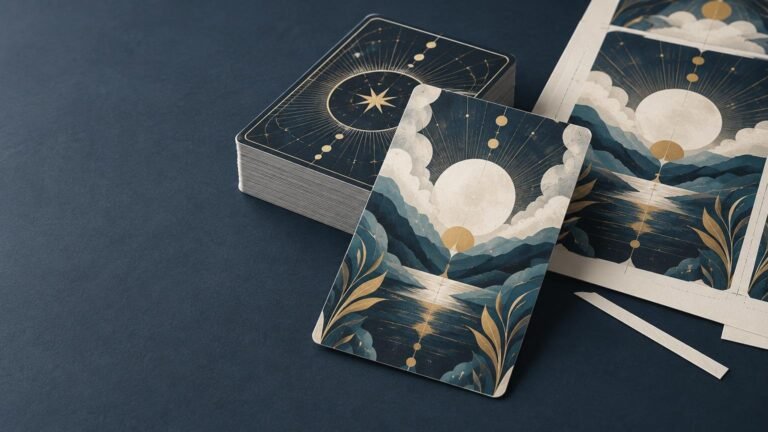
Full-Bleed Tarot Artwork: How to Avoid Uneven Printed Borders
Learn how to extend tarot artwork beyond the trim line, protect important details, handle borders and symmetry, and review files…
Read moreMove from a creative idea to a production-ready deck
Start with the card-family section closest to your project, then use the materials and printing coverage to investigate decisions shared across formats. Compare the tradeoffs behind cardstock, opacity, texture, protective finishes, color preparation, double-sided alignment, proofing and packaging without assuming one specification is best for every deck. The useful choice depends on the artwork, handling demands, presentation goals, card count, quantity and budget of the project in front of you.
Print Cards currently provides educational guidance and topic discovery. A future platform is planned to add product configuration, quantity-dependent pricing, deck and file uploads, proofing, packaging choices and ordering across the five card families. Until those capabilities launch, use the publication to define requirements, review production tradeoffs and build a clearer handoff. A well-prepared specification makes the next conversation with a printer more focused and gives each design decision a practical reason.
Custom Card Printing Questions
What kinds of card projects does Print Cards cover?
Coverage includes custom playing cards, original game cards and prototypes, trading and casual playtest cards, tarot and oracle decks, and flashcards and learning decks.
Can I order custom cards from Print Cards now?
Not yet. Print Cards currently provides educational guidance, while configuration, uploads, proofing, packaging and ordering are planned for a future platform.
How should I start preparing card artwork?
Begin by defining the card size, trim, bleed, safe area, front-and-back structure and printer requirements for image quality.
Which card size should I choose?
Choose a size based on handling, content and packaging. Familiar playing formats suit frequent shuffling, while illustrated or instructional decks may need more room for artwork or text.
What affects how a printed card feels?
Cardstock structure, thickness, surface texture and protective finish influence stiffness, shuffle behavior, glare and the appearance of printed color.
Why does card count matter before printing?
Card count affects deck thickness, packaging capacity, production setup and card-order economics, so it should be established early.
What should I check during proofing?
Review trim and safe areas, front-to-back orientation, shared backs, repeated elements, text readability, color expectations, card sequence and packaging fit.